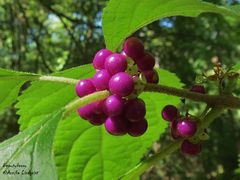
American Beautyberry
Callicarpa americanaAmerican Beautyberry is a shrub native to the Texas Hill Country that grows 4–8 ft tall and 6 ft wide. It wants shade and low to medium water, and handles clay soil. Blooms blue in early summer. Good for birds and butterflies.
Will it grow in your yard?
Enter your ZIP. The finder checks American Beautyberry against your microclimate, then ranks it against your sun, your watering and deer pressure.
From our guide
Village of the HillsLoose arching shrub with coarse leaves and startling clusters of magenta berries hugging the stems in fall.
Why it works here
The berry display is unmatched and it thrives in the dry shade under live oaks where most shrubs fail.
Watch out
Looks rangy without an annual cutback. Leaves droop dramatically when thirsty — usually a warning, not a death.
The facts
10 sources- Type
- Shrub
- Sun
- Shade (under 3 hrs)
- Water
- Low to medium
- Height
- 4–8 ft
- Spread
- 6 ft
- Bloom
- Early Summer · blue
- Foliage
- Deciduous
- Soil
- Takes clay · recorded on clay, dry, loam, moist, sand, well drained
- Deer
- Moderate — deer may browse it, especially new growth. Foliage browsed in dry years; berries usually left.
- Wildlife
- Supports birds and butterflies
Where it grows
Recorded in these EPA Level IV ecoregions in the Austin and Hill Country launch area:
4,075 occurrence records in Central Texas (GBIF).
Can you buy it?
Sold at local nurseries. Confirmed in stock at a Central Texas grower in these sizes:
also grows from seed It starts readily from seed, so a packet from a native-seed supplier, or seed collected with permission, is often the easiest way to get a plant no nursery pots.