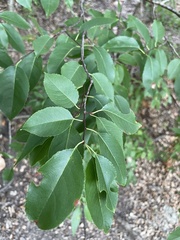
Escarpment Black Cherry
Prunus serotinaAlso called Black Cherry
Escarpment Black Cherry is a large tree native to Central Texas that grows 25–50 ft tall and 35 ft wide. It wants full sun and low to medium water, and handles caliche soil. Blooms white in late spring. Good for birds and butterflies.
Toxic — livestock. Cyanogenic foliage, especially when wilted. Kills cattle and horses.
Will it grow in your yard?
Enter your ZIP. The finder checks Escarpment Black Cherry against your microclimate, then ranks it against your sun, your watering and deer pressure.
From our guide
Village of the HillsUpright native cherry with glossy leaves, white flower spikes in spring and dark fruit in summer.
Why it works here
An Edwards Plateau endemic that belongs here in a way the eastern black cherry does not. Fruit is heavily used by birds.
Watch out
Wilted foliage is toxic to livestock. Tent caterpillars are cosmetic but unsightly. Wants a little more soil depth than pure caliche.
The facts
8 sources- Type
- Large tree
- Sun
- Full sun (6+ hrs)
- Water
- Low to medium
- Height
- 25–50 ft
- Spread
- 35 ft
- Bloom
- Late Spring · white
- Foliage
- Deciduous
- Soil
- Takes caliche · recorded on loam, moist, rich, sand, well drained
- Deer
- Low — deer eat it; cage or plant where they cannot reach. Browsed hard. Young trees need protection to get above the browse line.
- Wildlife
- Supports birds and butterflies
Where it grows
Recorded in these EPA Level IV ecoregions in the Austin and Hill Country launch area:
925 occurrence records in Central Texas (GBIF).
Can you buy it?
In the Village of the Hills guide, but not on the grower stock lists we read yet. Ask a native-plant nursery.
also grows from seed It starts readily from seed, so a packet from a native-seed supplier, or seed collected with permission, is often the easiest way to get a plant no nursery pots.