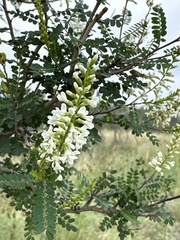
Kidneywood
Eysenhardtia texanaKidneywood is a small tree native to the Texas Hill Country that grows 8–15 ft tall and 6–8 ft wide. It wants full sun or part shade and very low water, and handles caliche and clay soil. Blooms white in May–Oct. Good for butterflies.
Will it grow in your yard?
Enter your ZIP. The finder checks Kidneywood against your microclimate, then ranks it against your sun, your watering and deer pressure.
From our guide
Village of the HillsOpen, fine-textured shrub with white flower spikes that appear off and on all season, usually after rain. Foliage smells like citrus when crushed.
Why it works here
Repeat bloom through summer, heavy butterfly and bee traffic, and complete indifference to drought and limestone.
Watch out
Loose and airy rather than dense — not a privacy screen.
The facts
8 sources- Type
- Small tree
- Sun
- Full sun to part shade (3+ hrs)
- Water
- Very low
- Height
- 8–15 ft
- Spread
- 6–8 ft
- Bloom
- May–Oct · white
- Foliage
- Deciduous
- Soil
- Takes caliche and clay · recorded on caliche, clay, dry, loam, sand, well drained
- Deer
- Moderate — deer may browse it, especially new growth. Young growth browsed
- Wildlife
- Supports butterflies
Where it grows
Recorded in these EPA Level IV ecoregions in the Austin and Hill Country launch area:
2,759 occurrence records in Central Texas (GBIF).
Can you buy it?
Sold at local nurseries. A Central Texas grower lists it; sizes were not published.
also grows from seed It starts readily from seed, so a packet from a native-seed supplier, or seed collected with permission, is often the easiest way to get a plant no nursery pots.