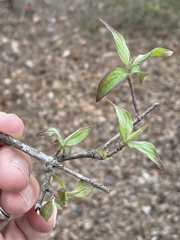
Roughleaf Dogwood
Cornus drummondiiRoughleaf Dogwood is a small tree native to the Texas Hill Country that grows 12–20 ft tall and 15–20 ft wide. It wants full sun or part shade and low water, and handles caliche and clay soil. Blooms white in mid spring. Good for birds and butterflies.
Will it grow in your yard?
Enter your ZIP. The finder checks Roughleaf Dogwood against your microclimate, then ranks it against your sun, your watering and deer pressure.
From our guide
Village of the HillsThicket-forming shrub with rough-textured leaves, flat white flower clusters and white fruit on red stems.
Why it works here
Serious bird plant — the fruit disappears fast. Handles part shade at a woodland edge and holds a bank together.
Watch out
Suckers hard and will form a colony. Give it a place where spreading is welcome, not a tidy bed.
The facts
7 sources- Type
- Small tree
- Sun
- Full sun to part shade (3+ hrs)
- Water
- Low
- Height
- 12–20 ft
- Spread
- 15–20 ft
- Bloom
- Mid Spring · white
- Foliage
- Deciduous
- Soil
- Takes caliche and clay · recorded on clay, dry, limestone, loam, moist, sand
- Deer
- Low — deer eat it; cage or plant where they cannot reach. Palatable. Expect browsing on anything within reach.
- Wildlife
- Supports birds and butterflies
Where it grows
Recorded in these EPA Level IV ecoregions in the Austin and Hill Country launch area:
2,804 occurrence records in Central Texas (GBIF).
Can you buy it?
In the Village of the Hills guide, but not on the grower stock lists we read yet. Ask a native-plant nursery.
also grows from seed It starts readily from seed, so a packet from a native-seed supplier, or seed collected with permission, is often the easiest way to get a plant no nursery pots.