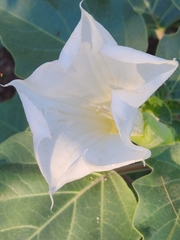
Sacred Datura
Datura wrightiiAlso called Datura
Sacred Datura is a perennial native to the Texas Hill Country that grows 4–5 ft tall and 4–5 ft wide. It wants full sun or part shade and low water, and handles clay soil. Blooms white in May–Nov. Deer rarely browse it. Good for moths and nectar insects.
Toxic — people, pets, livestock. Every part is deadly — tropane alkaloids. The canonical adolescent poisoning plant and a routine livestock killer. Do not plant where children play.
Will it grow in your yard?
Enter your ZIP. The finder checks Sacred Datura against your microclimate, then ranks it against your sun, your watering and deer pressure.
From our guide
Village of the HillsSprawling perennial with large gray-green leaves and huge white trumpet flowers that open at dusk.
Why it works here
Dramatic night-blooming flowers pollinated by hawkmoths, on a plant that needs nothing.
Watch out
Every part is seriously toxic — not for a yard with small children. Sprawls widely; give it three feet in every direction.
The facts
7 sources- Type
- Perennial
- Sun
- Full sun to part shade (3+ hrs)
- Water
- Low
- Height
- 4–5 ft
- Spread
- 4–5 ft
- Bloom
- May–Nov · white
- Foliage
- Deciduous
- Soil
- Takes clay · recorded on clay, dry, loam, sand, well drained
- Deer
- High — deer rarely browse it. Strongly toxic. Deer will not touch it.
- Wildlife
- Supports moths and nectar insects
Where it grows
Recorded in these EPA Level IV ecoregions in the Austin and Hill Country launch area:
531 occurrence records in Central Texas (GBIF).
Can you buy it?
In the Village of the Hills guide, but not on the grower stock lists we read yet. Ask a native-plant nursery.
also grows from seed It starts readily from seed, so a packet from a native-seed supplier, or seed collected with permission, is often the easiest way to get a plant no nursery pots.